How many of us when doing a lesson with our trainers think we have the right meaning of the terms they are throwing out at us? Especially in dressage. In many ways this is a completely new language to anyone trying to do lateral work and not only in dressage. It is hard enough to think of the “training scale” and then they throw in terms like; leg yield, shoulder-fore, shoulder-in, renvers, travers, pirouette, haunches-in, counter shoulder-in, etc. and to make things even more confusing some of these are the same thing, or are the same bend but in a different direction. AHHHHHH!
If you are like many of us, you think that you have it right in your mind until they throw new exercises into the mix. We as riders, use these terms all the time, but how much do we really know and understand the meaning and how to do these exercises as amateur’s – Like Shoulder-in to renvers (or haunches in)… What The Heck.. To make it even more confusing when you look at many pictures of the movements it all looks the same on paper and depends on the direction and wall side you are next to. Never mind how to actually do the exercise in the saddle. In actuality the exercise and the aids to the horse is a matter of understanding as a rider on what you are trying to do.
Haunches in looks the same as Renvers (wall on outside of the horse). [shoulders are on the straight line but the hips are off the the inside line] But put the wall on the inside of the horse and it is now a Travers.[Shoulders still on the straight line but the hip is on the outside line]
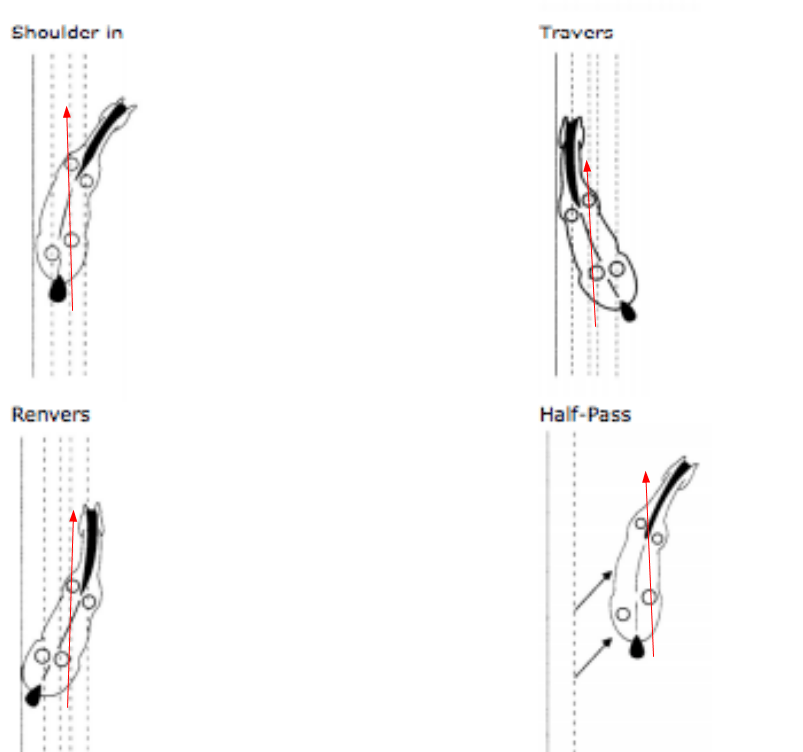
For Shoulder-in the wall is on the outside of the horse and Counter-shoulder-in the wall is now on the inside. [Hips are on the straight line] Many people visualize bananas to help them understand these concepts. Confused yet????
I know myself I frequently try to mimic the horse on the ground, to try and figure out what I am doing. We hear often your shoulders are the horses or your hips need to be on the same line as the horses when doing these different movements.
As a rider when we do this, we understand where we want the horses body parts to be, but do not necessarily understand how to get them there when on the horse. Frequently we are too heavy on the one or both reins and not strong enough in our legs and proper seat bones, then our bodies twist into pretzels trying to get our body to do what our mind thinks the movement is.
What a cruel joke our minds play here. The line needs to be the hips and not the shoulders for the horse to be considered straight. This is the concept that is so hard to see in our minds, as we cannot see the hind end of the horse only feel it. (and that takes time)
Again going back to the mimicking of the horse thru our own bodies, try doing a shoulder in against a wall. Keep your hips parallel to the wall but have your shoulders off the wall and do not collapse your torso (with your outside shoulder, as in line as you can make it, with your inside hip) – now try this away from the wall. Are you able to keep that angle or do you turn your hips to match your shoulders, or do you simply twist your shoulders even more?
Now think of what you need to do to get that movement in your horses body. Neck and head straight from the shoulder and the shoulders are moved over to the inside line (think 3 lines going forward in the direction you are moving)but the hips are still straight on the outside 2 lines. If you twist your shoulders too much you are applying too much rein on mouth/neck of that side and not keeping the horses head/neck/shoulders straight.
Once you are done with a movement, think you are moving back to the straight line forward (if only for a second) and then move onto the next exercise you are asked to do. The horse should still be going on the original straight line and not moved off to the 3rd line of the track. (shoulders are in-between the hip tracks) then you can move onto say a renver/haunches-in movement. A half-pass is staying in the shoulders-in and moving the horses whole body forward and sideways.
See I told you this was confusing. But the more you understand the concept of keeping your horse on these 3 lines the easier it should make doing these movements and the better for strengthening and suppling your horse for whatever discipline you ride.
 LSG Equine Consulting